What if learning the right business skills could make you more valuable to employers, improve how you manage people, and help you build stronger customer relationships?
That is exactly where an HRM and CRM Course in Nigeria can make a difference.
Businesses today need more than employees who can simply complete tasks. They need professionals who understand how to manage people, organise workplace processes, maintain customer relationships, and use business information effectively.
This is why Human Resource Management (HRM) and Customer Relationship Management (CRM) skills are becoming increasingly useful across different industries.
What Are HRM and CRM?
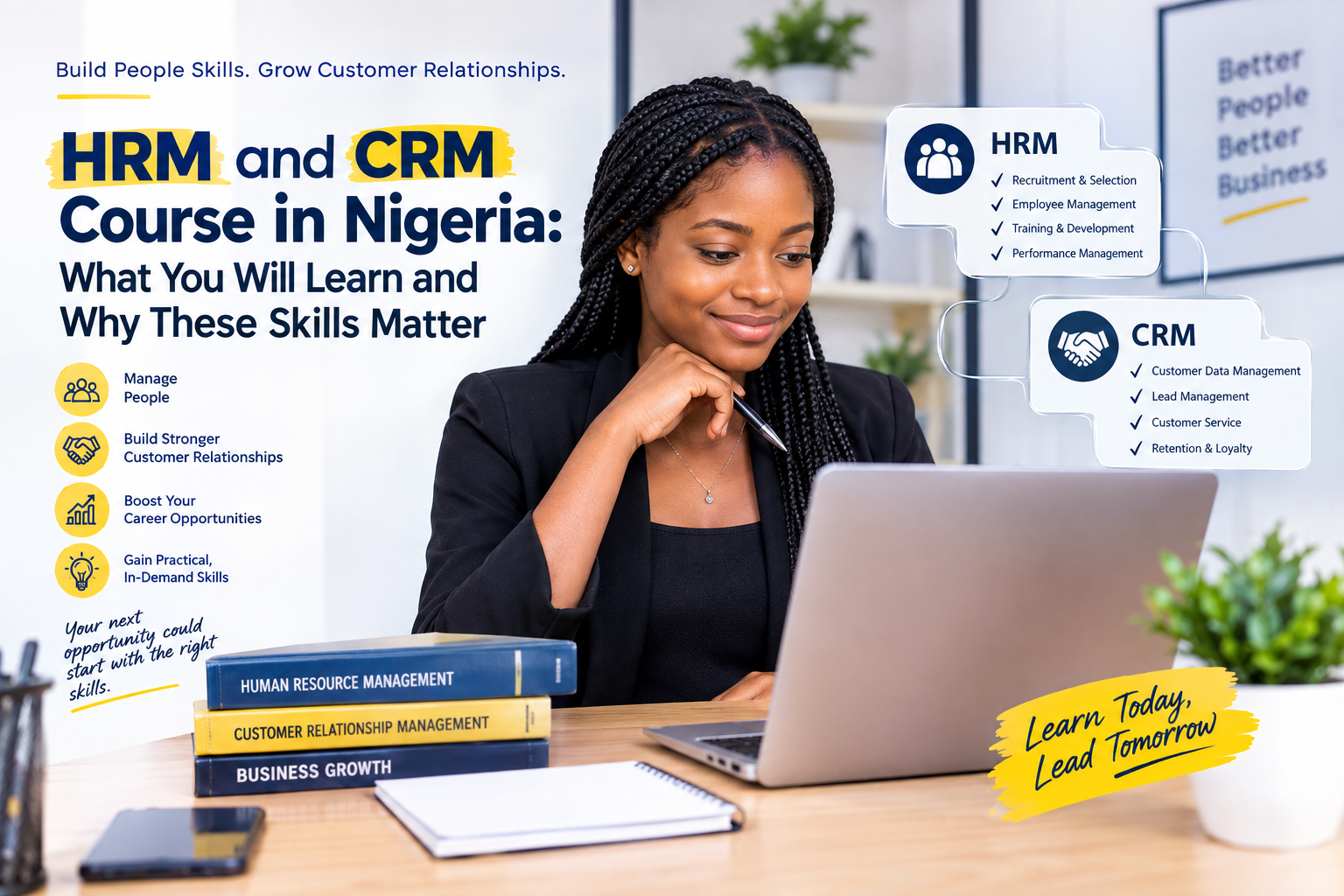
HRM, or Human Resource Management, focuses on managing people within an organisation. It covers areas such as recruitment, employee management, training and development, performance management, workplace communication, and employee engagement.
CRM, or Customer Relationship Management, focuses on how businesses interact with their customers. It involves managing customer information, tracking interactions, improving customer service, following up with leads, and building long-term customer relationships.
Although HRM and CRM deal with different areas of a business, they have something important in common: both are about managing relationships effectively.
HRM helps businesses manage their relationship with employees, while CRM helps them manage their relationship with customers.
Why Are HRM and CRM Skills Important in Nigeria?
Think about a business with great products but poor customer service. Customers may leave.
Now think about a company with many employees but poor communication, weak recruitment processes, and no proper employee management. Productivity can suffer.
This shows why businesses need professionals who understand both people and relationship management.
An HRM and CRM Course in Nigeria can help learners develop practical knowledge that can be applied in different workplace environments, from small businesses and startups to large organisations.
These skills can be useful for people interested in careers in:
- Human resources
- Customer service
- Administration
- Sales and business development
- Recruitment
- Office management
- Operations
- Marketing
- Client relationship management
What Will You Learn in an HRM and CRM Course?
One of the biggest advantages of taking an HRM and CRM course is that you can gain knowledge in two important areas of business management.
1. Human Resource Management
You can learn how organisations manage their employees from recruitment to development.
Topics may include:
- Recruitment and selection
- Employee onboarding
- Training and development
- Performance management
- Employee engagement
- Workplace communication
- HR policies and procedures
- Employee records and documentation
Understanding these areas can help you appreciate what goes on behind the scenes when a company hires, develops, and manages its workforce.
2. Customer Relationship Management
CRM training focuses on creating better relationships between businesses and their customers.
You can learn about:
- Customer data management
- Customer communication
- Lead management
- Customer follow-up
- Sales pipelines
- Customer retention
- Complaint management
- CRM tools and systems
The goal is not simply to collect customer information. It is to understand how businesses can use that information to provide better experiences and make smarter decisions.
HRM + CRM: Why Learn Both?
Here is where things become particularly interesting.
Imagine you work for a company where the HR team needs to recruit customer service representatives. Understanding HRM helps you know how to recruit and manage those employees.
But understanding CRM helps you understand the customers those employees are expected to serve.
You therefore gain a broader understanding of how people, processes, and customers connect within a business.
For professionals who want to become more versatile, learning both HRM and CRM can provide knowledge that crosses different departments.
Who Should Take an HRM and CRM Course?
You don’t necessarily need to be an HR professional or an experienced business owner to benefit from the training.
An HRM and CRM Course in Nigeria can be suitable for:
Students and graduates who want to develop practical workplace skills before entering the job market.
HR professionals who want to strengthen their understanding of employee management and modern business systems.
Business owners and entrepreneurs who want to improve how they manage employees and customers.
Administrative professionals who want to expand their responsibilities and career opportunities.
Sales and customer service professionals who want to understand CRM processes and customer relationship management better.
Why Practical Training Matters
Knowing what HRM and CRM stand for is one thing. Knowing how to apply the concepts in a real workplace is another.
Good training should help learners move beyond definitions and understand how these systems work in everyday business situations.
For example, instead of simply learning what a CRM system is, learners should understand how businesses can use customer information to track leads, follow up with prospects, monitor interactions, and improve customer retention.
Similarly, HRM training should go beyond the meaning of recruitment and help learners understand how recruitment, onboarding, employee development, and performance management work together.
Build Skills That Can Grow With Your Career
The workplace continues to change, and employers increasingly value professionals who can adapt to different responsibilities.
Learning HRM and CRM can give you knowledge that applies across multiple business functions.
Whether you are preparing for your first job, looking to improve your professional skills, or trying to understand how modern businesses manage employees and customers, structured training can give you a stronger foundation.
Ready to Learn HRM and CRM?
If you’re looking for an HRM and CRM Course in Nigeria, Recruit Tech provides training designed to help learners understand these essential business functions and develop practical knowledge they can apply in the workplace.
Don’t just learn what HRM and CRM mean. Learn how they work, why businesses use them, and how these skills can become part of your professional toolkit.
Start building the knowledge you need to understand people, manage relationships, and contribute more effectively to modern businesses with an HRM and CRM Course in Nigeria.