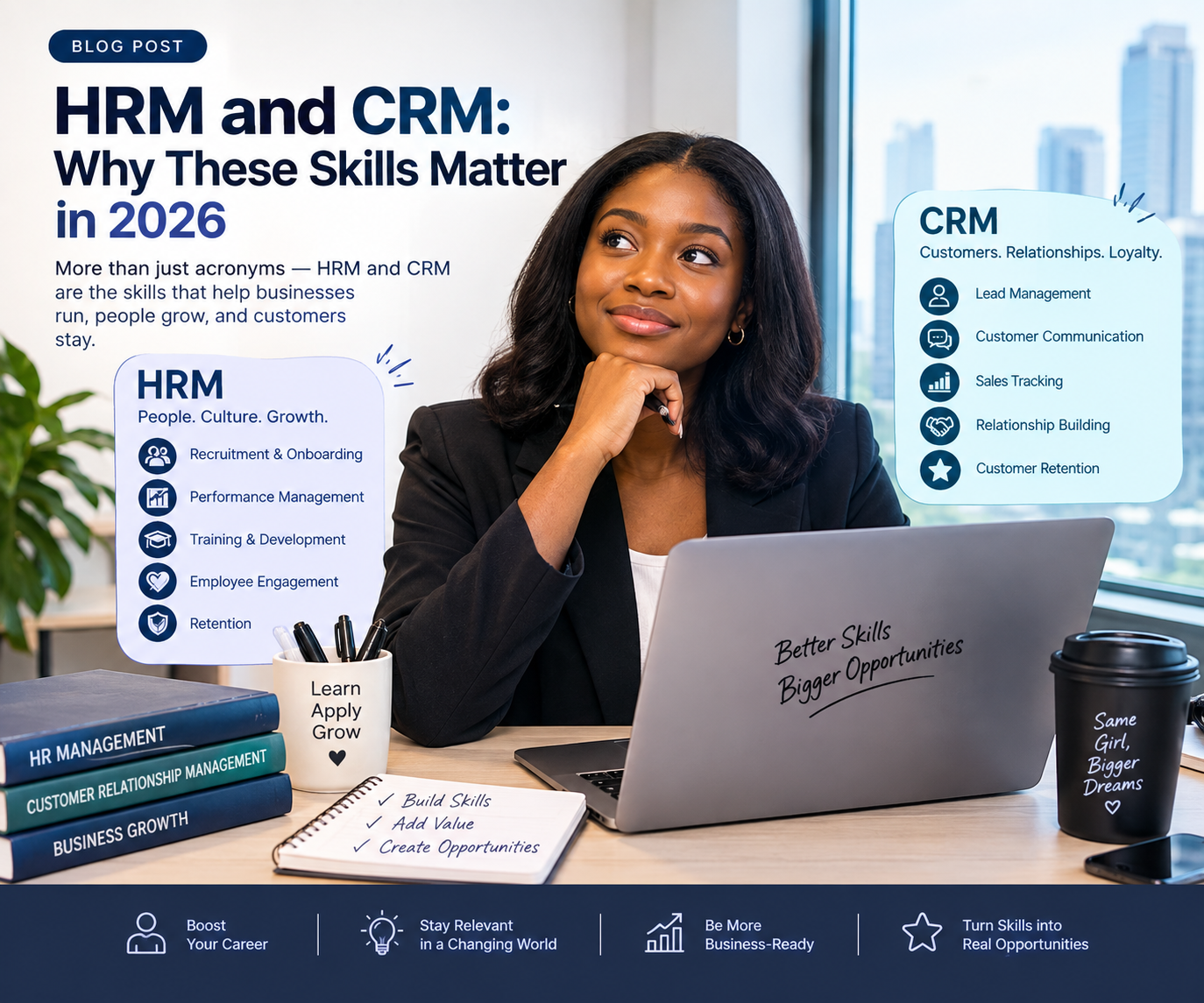
HRM and CRM are no longer just technical terms you see in job descriptions. In 2026, they represent two of the most valuable skill areas for professionals who want to understand people, manage relationships, improve business operations, and stay relevant in a competitive job market.
But here is the question many professionals and job seekers are beginning to ask: Why are companies placing so much importance on HRM and CRM skills?
The answer goes beyond simply knowing how to use software.
The Workplace Is Changing — Are Your Skills Keeping Up?
Technology has changed how businesses hire employees, communicate with customers, track performance, and make decisions.
Companies are no longer looking only for candidates with academic qualifications. Employers increasingly value professionals who can combine people skills, technology, communication, organisation, and data-driven decision-making.
This is where HRM and CRM become particularly important.
Human Resource Management (HRM) focuses on managing employees throughout their journey within an organisation — from recruitment and onboarding to performance management, development, engagement, and retention.
Customer Relationship Management (CRM) focuses on managing interactions with customers and prospects, helping businesses understand their needs, improve communication, strengthen relationships, and support sales and customer retention.
Put simply, HRM helps organisations manage their people, while CRM helps them manage their customer relationships.
And modern businesses need both.
Why HRM Skills Matter in 2026
Employees are one of the biggest assets of any organisation. However, managing people effectively requires more than simply hiring and paying staff.
Modern HR professionals need to understand recruitment, employee engagement, performance management, workplace communication, training, employee data, and retention.
For example, an organisation may have excellent products and services but still struggle if it cannot attract the right employees or keep its best talent.
HRM skills can help professionals understand how to:
- Support effective recruitment and onboarding
- Manage employee information and records
- Monitor employee performance
- Improve workplace communication
- Support employee training and development
- Contribute to employee retention strategies
- Use HR technology to improve administrative processes
These skills are useful not only for HR professionals. Managers, administrators, entrepreneurs, team leaders, and business owners can also benefit from understanding how effective people management works.
And Then There Is CRM…
Imagine a business attracting hundreds of potential customers every month but failing to follow up with them.
Some customers receive messages late. Others have their information scattered across different platforms. Sales teams forget previous conversations, while customer complaints take too long to resolve.
That business may not have a marketing problem.
It may have a customer relationship management problem.
CRM systems help businesses organise customer information, track interactions, monitor sales activities, manage leads, and improve customer communication.
Learning CRM can therefore help professionals understand how businesses turn leads into customers and customers into long-term relationships.
The Real Power Comes When HRM and CRM Skills Meet
Here is where things become interesting.
Many people think HRM and CRM belong to completely different departments. While they serve different functions, both require professionals to understand people, communication, information, technology, and relationships.
A professional who understands HRM and CRM can have a broader understanding of how an organisation operates.
For example, imagine a business launching a new product.
The HR team needs the right employees with the right skills to support the launch. Meanwhile, the sales and customer-facing teams need to understand potential customers, track leads, communicate effectively, and maintain relationships.
HRM supports the people behind the operation.
CRM supports the relationships that drive the business.
Together, they can contribute to a more organised and customer-focused organisation.
Why Employers Are Looking for These Skills
Businesses today have access to more information and technology than ever before. However, technology is only useful when people know how to use it effectively.
Employers need professionals who can adapt to digital tools, understand business processes, communicate effectively, and work with information.
This makes HRM and CRM knowledge valuable across several career paths, including:
Human Resources: Recruitment, employee management, training, performance management, and HR operations.
Sales: Lead management, customer follow-up, sales pipelines, and relationship building.
Marketing: Customer insights, segmentation, campaign tracking, and communication.
Administration: Record management, reporting, coordination, and process improvement.
Customer Service: Customer information management, communication, complaint resolution, and retention.
Entrepreneurship: Managing employees while building and maintaining customer relationships.
The skills can therefore extend beyond one specific job title.
HRM and CRM in the Age of AI
Another reason these skills matter in 2026 is the growing use of artificial intelligence and automation in business.
AI can help businesses analyse information, automate repetitive tasks, generate reports, identify patterns, and improve workflows.
But AI does not eliminate the need for people who understand why the information matters and how to act on it.
A professional who understands HRM can better interpret employee-related information and processes. Someone with CRM knowledge can better understand customer data, sales activities, and relationship management.
The combination of human understanding and digital skills can make professionals more adaptable as workplaces continue to evolve.
Who Should Learn HRM and CRM?
You do not necessarily need to be an HR manager or sales executive to benefit from these skills.
HRM and CRM can be useful for:
- Students preparing for the workplace
- Recent graduates building their CVs
- HR professionals
- Sales and marketing professionals
- Business owners
- Entrepreneurs
- Administrative professionals
- Customer service professionals
- Managers and team leaders
- Anyone looking to develop practical digital business skills
If your career involves people, customers, communication, business operations, or technology, these skills can add value to your professional toolkit.
The Bigger Career Advantage
Qualifications can help you get noticed, but practical skills can help you demonstrate what you can actually do.
Learning HRM and CRM can give you exposure to real business processes and help you understand how organisations manage their internal teams and external relationships.
More importantly, these skills can help you become more comfortable working with modern business systems.
The goal isn’t simply to add another certificate to your CV.
It is to develop skills that you can apply.
Ready to Build Skills That Businesses Actually Use?
The workplace is changing quickly, and professionals who continue learning can position themselves to adapt to those changes.
Whether you want to work in HR, sales, marketing, administration, customer service, or eventually build your own business, understanding HRM and CRM can give you a broader view of how organisations manage people and relationships.
In 2026, businesses need professionals who can do more than understand theory. They need people who can work with technology, communicate effectively, understand customers, support teams, and contribute to business growth.
That is why learning HRM and CRM is not simply about learning two business concepts — it is about developing practical skills for the modern workplace.
Ready to take the next step? Explore an HRM and CRM course and start building skills you can apply to real-world business situations.