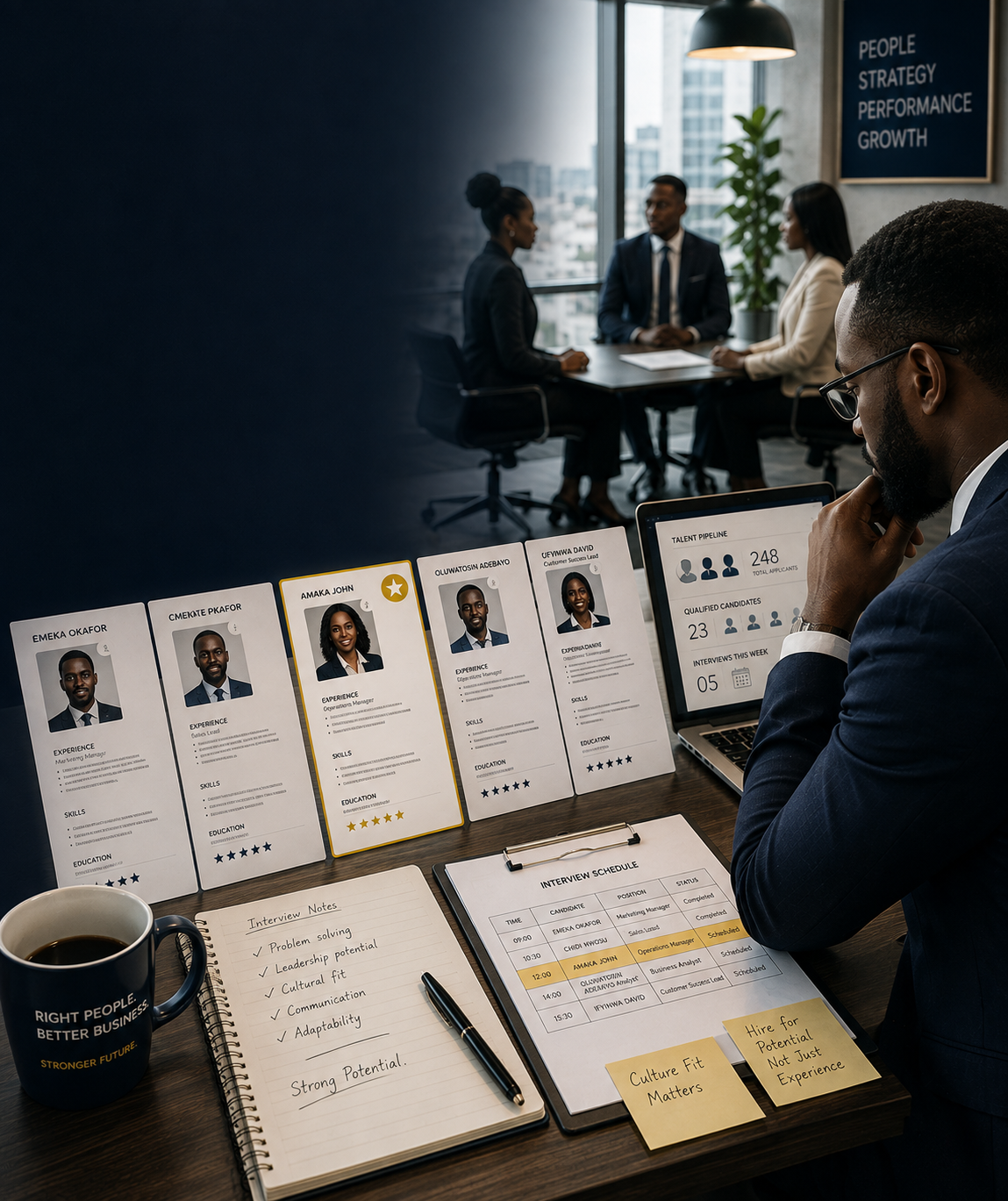
The problem may not be that Nigeria doesn’t have enough qualified professionals. The problem may be that businesses are looking for them in the wrong way. If you are trying to understand how to hire qualified employees in Nigeria, the answer goes beyond posting a vacancy, collecting CVs, and choosing the candidate with the most impressive qualifications. The right candidate may already be out there, but your recruitment process may be preventing you from finding them.
The Hiring Problem Is Not Always a Talent Problem
A business can receive hundreds of applications for one position and still struggle to find the right person.
Why?
Because having more applicants does not necessarily mean having more qualified candidates.
Some applicants may not meet the basic requirements. Others may have the right qualifications but lack practical experience. Some may interview well but struggle once they start working.
Then there are candidates who could actually be excellent employees but never make it past the first stage because their CV does not immediately stand out.
This creates a frustrating cycle.
Post vacancy. Receive applications. Review CVs. Interview candidates. Hire someone. Discover the fit is wrong. Start again.
The problem isn’t always the talent pool.
Sometimes, it is the process.
Your CV Screening Process Could Be Eliminating Great Candidates
CVs are useful, but they don’t tell the whole story.
A candidate might not have the perfect job title or exact number of years of experience, yet possess the problem solving ability, adaptability, communication skills, and potential your business needs.
For example, imagine you are hiring a marketing executive.
Candidate A has five years of experience and an impressive CV but has mostly worked within highly structured organisations.
Candidate B has two years of experience but has independently managed campaigns, built a small business, learned several digital tools, and demonstrated strong initiative.
If you only look at years of experience, Candidate A may win.
If you look at potential and capability, Candidate B might be the better hire.
This is why effective recruitment requires more than ticking boxes.
Are You Hiring for Experience or Ability?
Experience matters.
But experience should not become a shortcut for evaluating talent.
Businesses should ask:
Can this person solve the problems we need them to solve?
Can they learn quickly?
Can they communicate effectively?
Can they work with the existing team?
Can they take responsibility without constant supervision?
These questions reveal much more about a candidate’s potential than a CV alone.
The best hiring decisions balance experience with capability.
The Job Description Matters More Than You Think
Sometimes, the wrong candidates apply because the job description is unclear.
If your vacancy says:
“We are looking for a hardworking individual with good communication skills.”
You haven’t told the candidate much.
What does the person actually need to achieve?
What does success look like?
What skills are essential?
What will they learn?
What problems will they solve?
A strong job description should make it easy for the right candidate to recognise themselves in the opportunity.
It should also make it easier for unsuitable candidates to recognise that the role isn’t for them.
That alone can improve the quality of applications you receive.
Your Employer Brand Could Be Turning Away Top Talent
Here’s something many employers overlook.
Candidates are evaluating your company too.
Before accepting a job, professionals may research your website, LinkedIn page, social media accounts, leadership team, employee reviews, and company culture.
They want to know:
What is it actually like to work here?
If your company has a poor reputation, unclear culture, limited career development, or little information about its employees and work environment, strong candidates may choose another employer.
This means recruitment doesn’t begin when someone applies.
It begins when they first discover your company.
The Interview Can Also Lead You to the Wrong Hire
Interviews are supposed to help employers make better decisions.
But an unstructured interview can do the opposite.
If every candidate is asked different questions, evaluated differently, and judged mainly on whether the interviewer “likes” them, personal bias can easily influence the outcome.
A structured interview gives every candidate a fairer opportunity to demonstrate their ability.
Ask questions that reveal:
- How they solve problems
- How they handle pressure
- How they communicate
- How they approach difficult situations
- How they work with others
- How they respond to mistakes
- How they learn new skills
The goal is not to find the person who gives the best interview.
The goal is to find the person who can perform the job.
Cultural Fit Should Not Mean “Someone Like Us”
Culture matters.
But it can be misunderstood.
Sometimes employers say they want someone who fits their culture when what they really mean is someone who behaves, communicates, or thinks like the existing team.
That can create a less diverse and less innovative organisation.
Instead, focus on values and behaviours.
Does the candidate demonstrate integrity?
Are they accountable?
Can they collaborate?
Are they willing to learn?
Can they respect different perspectives?
These are much healthier measures of cultural alignment.
Speed Can Make or Break a Good Hire
Imagine finding an excellent candidate.
They have the right experience.
They performed well during the interview.
They are excited about the opportunity.
Then your company takes three weeks to make a decision.
During that time, another organisation makes them an offer.
You lose the candidate.
This happens more often than businesses realise.
A good recruitment process needs to be thorough, but it also needs to be efficient.
The longer you leave great candidates waiting, the more likely you are to lose them.
What Smart Employers Do Differently
Businesses that consistently build strong teams don’t simply hope the right people will apply.
They create systems for finding them.
They:
Define the role clearly
They know exactly what success looks like before recruitment begins.
Look beyond CVs
They assess capability, potential, and behaviour alongside experience.
Build a strong employer brand
They give talented professionals a reason to want to join.
Use structured interviews
They evaluate candidates consistently instead of relying on gut feeling.
Move quickly
They don’t allow unnecessary delays to cost them strong candidates.
Use multiple talent sources
They don’t depend entirely on job boards to find people.
Sometimes, You Need to Look Beyond Active Job Seekers
One of the biggest recruitment opportunities is finding professionals who aren’t actively applying for jobs.
Some of the strongest candidates are already employed.
They may not be checking job boards every morning.
But they may be open to the right opportunity.
This is where professional networks, referrals, talent databases, direct sourcing, and recruitment partners can make a significant difference.
Instead of waiting for candidates to find you, you can actively search for the people who fit what your business needs.
When Should You Consider a Recruitment Partner?
If your business consistently receives unsuitable applications, struggles to identify qualified candidates, takes too long to fill vacancies, or has experienced repeated bad hires, it may be time to reconsider your recruitment strategy.
A recruitment partner can help with candidate sourcing, screening, assessments, interviews, talent mapping, and shortlisting.
The objective isn’t to take hiring decisions away from your business.
It is to give your team access to better processes and a wider talent pool.
The Right Hire Can Change the Business
A great employee does more than fill a vacant position.
They solve problems.
They improve processes.
They serve customers.
They support colleagues.
They introduce new ideas.
They create opportunities.
And sometimes, they become the person who helps the business reach its next level.
That is why recruitment deserves more attention than simply asking, “Who is available?”
The better question is:
“Who can help us become better?”
Final Thoughts
The right candidate is often out there, but businesses need the right strategy to find them. Hiring successfully requires more than advertising vacancies and choosing candidates based on CVs alone. It requires clear job descriptions, effective candidate sourcing, structured assessments, strong employer branding, and a recruitment process that recognises both experience and potential. Ultimately, how to hire qualified employees in Nigeria comes down to building a process that helps your business identify the people who can genuinely contribute to its growth.
At RecruitTech, we help businesses find, assess, and connect with qualified professionals who match their roles and organisational needs. Because the goal of recruitment isn’t to find someone who can simply fill the position.
It’s to find the person who can make the position matter.